.png?width=240&height=72&name=Untitled%20design%20(22).png "Untitled design (22)")


By Luke Hutchinson on Dec 8, 2025, 10:00:00 AM
Energy costs represent one of the largest controllable expenses in manufacturing, yet many facilities continue to heat and cool far more space than necessary. Controlling temperature in large, open-plan facilities accounts for a substantial share of operational expenditure, and with industrial electricity prices still 75% higher than they were at the start of 2021, the financial pressure on manufacturers has never been greater.
The output of UK energy-intensive industries has fallen by over a third since 2021, with rising energy costs cited as a significant contributing factor. For businesses operating high-bay warehouses or production spaces with large volumes of unoccupied air, the challenge is particularly acute.
The problem is simple but costly: most factories and warehouses are conditioned as single, open spaces, even though only a portion of the area is actively used at any given time. Heating or cooling entire volumes of air, especially when ceilings exceed six metres and loading bay doors are in constant use, leads to significant energy waste.

Creating Controlled Zones for Maximum Efficiency
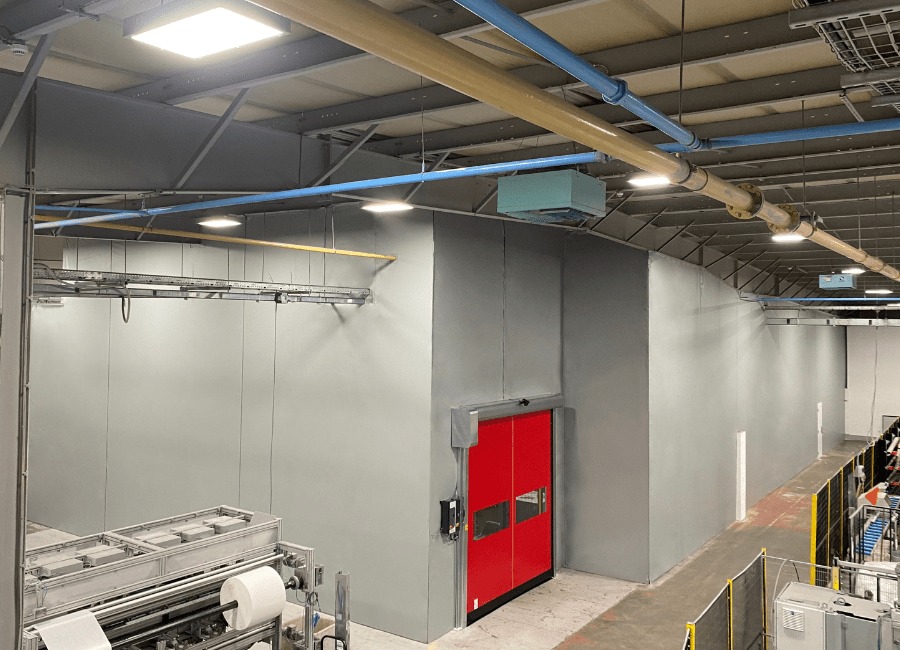
The most effective way to reduce this waste is through zone control: dividing the workspace into smaller, more manageable areas using factory partition walls. By isolating high-use zones, such as production lines, packaging areas or quality control stations, from low-traffic storage or logistics spaces, businesses can target heating and cooling only where it's needed.
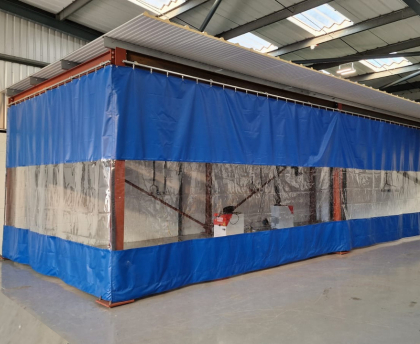
Modern warehouse partition walls and flexible curtain systems provide a fast, low-disruption solution for achieving this. They effectively contain conditioned air, prevent temperature drift and block heat loss through open doorways and roller shutter access points.
Research from the US Department of Energy demonstrates that commercial buildings implementing zone control and building automation measures can achieve average total energy savings of 29%. Whilst individual results vary by facility layout and usage patterns, studies on zone control systems show energy savings ranging from 15% to 29% when zones are managed effectively.
In practical terms, partitioning allows manufacturers to create permanent zones that can be heated or cooled independently, reducing energy consumption in typical industrial environments by 15-30%, depending on the layout and number of controlled zones created.
Real Savings, Measurable ROI
When viewed as a capital investment, internal partitioning systems often deliver one of the fastest payback periods of any energy efficiency measure.
Consider a typical scenario for a facility operating multiple production lines:
- A medium-sized factory spends £120,000 per year on gas and electricity, with heating and cooling representing approximately 40% (£48,000) of that total
- Introducing partitioning to isolate key production zones typically reduces temperature control costs by 20%. In this scenario, that delivers annual savings of £9,600
- If the total installed cost of the partition system is £30,000, the payback period would be approximately 3.1 years, with ongoing savings continuing for the lifespan of the system (typically 10-15 years)
This makes heat partitions not only a practical operational improvement but a financially strategic one, freeing up annual budget for reinvestment elsewhere whilst protecting facilities from volatile energy prices.
Real-World Applications
The effectiveness of zoned temperature control has proven valuable across diverse manufacturing environments.
When Nikon's UK facility contacted us, they were facing rapid temperature drops every time their large roller shutter door opened, interfering with sensitive microchip testing equipment. We installed a flexible PVC partition system suspended from roof purlins, creating a fully sealed zone that maintained stable temperatures regardless of external door activity. The result was improved equipment performance and more comfortable working conditions for staff.
Harrison Spinks faced similar challenges following process changes that introduced soap residue and dust contamination. A 40-metre flexible partition wall not only contained the contamination but helped maintain more stable environmental conditions within their production area, contributing to better process control and reduced energy waste from uncontrolled air movement.
Additional Benefits Beyond Energy Reduction
Beyond cost savings, partitions offer other tangible operational advantages. They help maintain stable temperatures for sensitive equipment, improve comfort for personnel and support seasonal efficiency by retaining heat during winter and reducing cooling loads in summer.
There's also an important sustainability consideration. Lower energy consumption directly reduces carbon emissions, supporting net zero commitments and Scope 1 & 2 emissions reduction targets. For manufacturers facing increasing scrutiny on environmental performance, partitioning provides documented energy savings that can be included in sustainability reporting and ESG disclosures.
A Smart Investment for Long-Term Savings
In an era of persistently high energy prices and strengthening sustainability requirements, partitioning offers a compelling combination: reduced operational costs, improved environmental performance and better working conditions, all with a rapid return on investment.
Whether through flexible PVC partitions or permanent insulated partition walls, controlling the temperature of specific zones rather than entire facilities represents one of the most cost-effective energy efficiency measures available to manufacturers today.
Looking to reduce energy costs whilst improving operational efficiency? Discover how partition systems can deliver measurable savings. Contact us today to discuss your requirements.
Control Temperature Fluctuations in Your Warehouse with Industrial Partitions
How Warehouse Partitioning Systems Transform Large Manufacturing Facilities
No Comments Yet
Let us know what you think