.png?width=240&height=72&name=Untitled%20design%20(22).png "Untitled design (22)")

By Luke Hutchinson on Feb 4, 2026, 12:00:00 PM
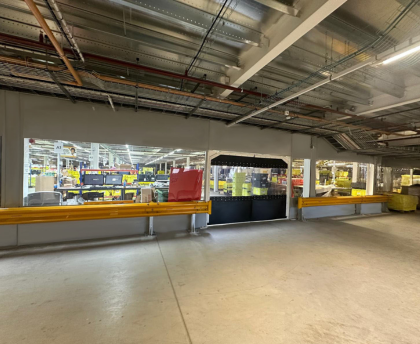
Large manufacturing facilities are rarely static. Production volumes change, new equipment is introduced, processes evolve and regulatory requirements tighten. Yet many warehouses and factories are still expected to operate within layouts that were designed years, sometimes decades earlier.

Outdated layouts can lead to production inefficiencies, frustrated workers and worse still, a dip in productivity and profits.
Warehouse partitioning systems offer a practical way for large organisations to adapt their facilities without the cost, disruption or inflexibility of permanent construction. When designed and delivered at scale, these systems enable manufacturers to rapidly improve efficiency, compliance and environmental control across complex sites.
Rethinking Space In Large-Scale Facilities
In major manufacturing environments, space is one of the most valuable assets. However, traditional building methods such as block walls or steel stud partitions often lack the flexibility and agility required for modern operations.
Warehouse partition wall systems allow businesses to:
-
Create segregated production zones without structural alterations rapidly and with minimal disruption
-
Redefine workflows as operational requirements change
-
Protect sensitive processes from dust, temperature fluctuation, or contamination
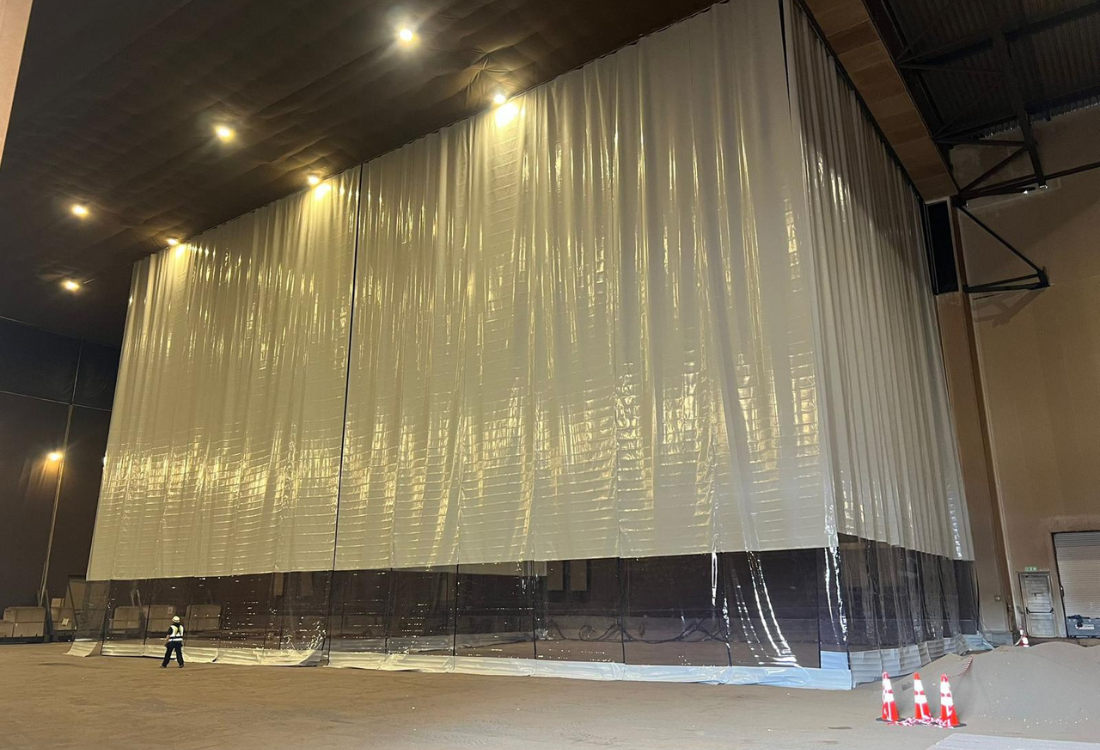
For large facilities, this adaptability is critical. Partitioning projects regularly exceed 100 metres in length and reach heights of 18 metres or more, equivalent to a two-storey structure, enabling substantial areas to be enclosed quickly and effectively.
Solving Complex Operational Challenges
Large manufacturing sites rarely present simple, rectangular spaces. Structural columns, machinery layouts, and access routes often require partitioning systems to be configured around real-world constraints.
Modern warehouse partitions can be engineered into:
-
L-shaped layouts to divide production areas efficiently
-
U-shaped enclosures for spray booths or testing zones
-
Fully sealed environments for contamination or temperature control
These bespoke configurations allow manufacturers to address challenges that standard off-the-shelf solutions cannot resolve.
At ADE Power, for example, a 60m x 7m spray booth our structures had to accommodate full-size shipping containers. This level of enclosure demands not only material performance, but engineering capability and manufacturing scale.
Supporting High-Value And Sensitive Processes
As manufacturing processes become more specialised, environmental control becomes increasingly important.
Warehouse partitioning systems are frequently used to:
-
Prevent cross-contamination between production areas
-
Isolate dust-generating processes
-
Protect sensitive equipment from temperature variation and airborne particles
At Harrison Spinks, we installed a 7m x 40m tension wall to segregate production areas and maintain consistent conditions. Similarly, partitioning solutions have been deployed in precision environments such as Nikon’s microchip testing facilities, where dust control and environmental stability are critical.
For large manufacturers, these systems support compliance, product quality and operational reliability.
Industries That Rely On Large-Scale Partitioning
Warehouse partitioning systems are now a core infrastructure component across multiple sectors, including:
-
Automotive manufacturing, where production zoning and dust control are essential.
-
Food and beverage, requiring hygiene segregation and allergen management.
-
Aerospace and precision engineering, where environmental stability impacts quality.
-
Logistics and distribution, enabling flexible space allocation.
-
Construction and temporary works, where rapid enclosure is required.
In each case, scale matters. Delivering effective partitioning across large sites requires robust engineering, reliable materials, and installation expertise.
The Importance Of Manufacturer Capability
Not all partitioning providers are equipped to deliver large-scale projects. Many rely on third-party supply chains, which can introduce delays, design limitations and inconsistent quality.
Delivering warehouse partitioning at industrial scale requires:
-
In-house manufacturing capacity
-
Engineering expertise to design bespoke configurations
-
Installation teams experienced in live manufacturing environments
Manufacturer-installers like Hutchinson PVC are uniquely positioned to meet these demands, controlling the process from design through to completion.
In fact, we have delivered partitioning systems for household-name UK manufacturers, demonstrating the capability to manage major contracts where technical performance and delivery certainty are critical.
Speed Without Compromising Operations
One of the key advantages of warehouse partitioning systems is the speed at which they can be installed.
Unlike traditional construction methods, flexible partition systems:
-
Can be installed from existing steel works
-
Requires no painting or finishing
-
Conforms to stringent flame retardancy standards
-
Can often be installed around live production
This allows large facilities to implement changes with minimal operational disruption which is a major consideration where downtime directly impacts revenue.
A Strategic Tool For Large Manufacturers
Warehouse partitioning systems are now an integral part of large manufacturing infrastructure enabling them to respond quickly to changing facility and production demands. .
When delivered by an experienced manufacturer-installer, these systems provide:
-
Scalable, bespoke solution
-
Faster project delivery
-
Reduced risk and improved accountability
As manufacturing environments continue to evolve, flexible partitioning offers a future-proof way to optimise space without locking facilities into permanent constraints.
Planning a large-scale partitioning project? We specialise in complex installations for major manufacturing facilities. Get in touch to discuss your requirements.
When Is A Temporary Warehouse Partition The Smartest Choice
How Warehouse Partitioning Systems Improve Climate & Combat Dust
No Comments Yet
Let us know what you think