


By Luke Hutchinson on Nov 25, 2026, 10:00:01 AM
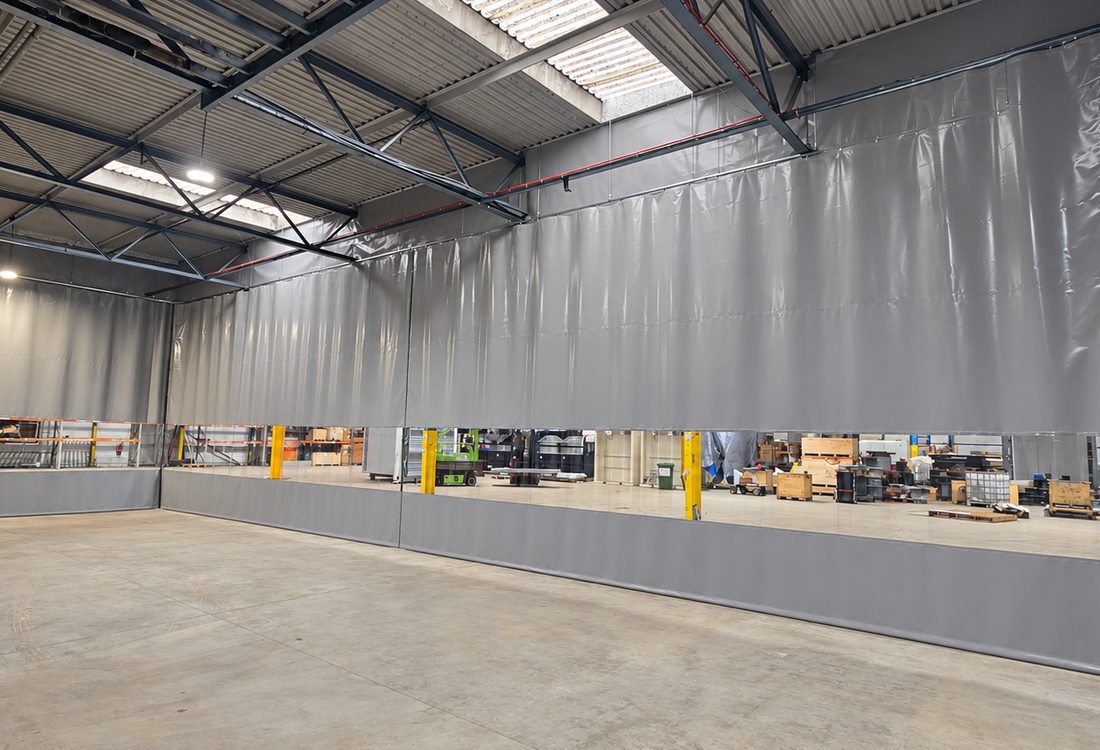
Noise really is a nuisance, and not just because it means you have to shout to make yourself heard. In industrial environments, constant or excessive noise can affect the health and wellbeing of your staff far beyond making it difficult to have a normal conversation.
According to the Health and Safety Executive, an estimated 16,000 workers each year had hearing problems caused or made worse by work between 2023/24 and 2025/26, with a further 45 new cases of occupational deafness assessed in 2025.
Achieving effective industrial noise control for workshop environments is one of the most common health and safety challenges in industrial workshops, and it’s not always obvious how to bring levels down without a major building project. Here we look at what UK regulations require, why open workshops often feel louder than they need to and how workshop curtains offer a genuine, practical way to reduce noise reaching adjacent work areas.

What The Noise At Work Regulations Require
Under the Control of Noise at Work Regulations 2005, employers must assess the risk once daily or weekly average exposure reaches 80 dB(A), provide hearing protection from 85 dB(A) and ensure no worker is exposed above the 87 dB(A) exposure limit. This limit takes account of any reduction provided by hearing protection.
These thresholds apply across the working day, so even intermittent loud processes can push average exposure into territory that requires action. Understanding where your workshop sits against these figures is the first step before considering any noise control measures, including PVC curtain screening.
Why Open Plan Workshops Feel Louder
Sound does not simply travel through the air in a straight line; it reflects off hard surfaces such as concrete floors, steel racking and bare walls. This is a major reason why open-plan warehouses and workshops tend to feel louder than smaller, more broken-up spaces, even when the source of the noise is the same.
Every hard, flat surface adds to the reflected noise bouncing around the room, which increases the overall level that workers experience throughout the space rather than just close to the machinery causing it. Overlapping conversations and chatter can also add further to the noise, making it harder for the human brain to focus on speech.
How Much Can A PVC Curtain Actually Reduce Noise?
Standard PVC curtains with the right thickness and density can reduce noise levels by a meaningful amount in real-world tests, with well-specified curtains typically cutting transmitted noise by somewhere in the region of 12 dB. We also specifically design sound barrier curtains with dedicated sound protection qualities and built-in foam, which absorbs sound much better than standard PVC.
Thicker, heavier grades absorb and deflect more sound energy than lighter ones, and increasing the overlap between strips helps close the small gaps that noise can otherwise travel straight through. While this will not match the performance of a solid acoustic wall, it is a significant reduction for a flexible, cost-effective solution that does not require permanent construction.
What Curtains Cannot Replace
It is important to be clear that curtains are not a replacement for a proper noise risk assessment or for hearing protection where required. They work alongside these measures rather than instead of them, helping reduce the noise reaching adjacent work areas, offices or break rooms rather than removing the need for protection at the source of the noise itself. Factory noise control should always start with identifying and managing the loudest processes directly, with curtains used as an additional layer to contain and reduce noise spreading further through the building.
However, in situations where installing permanent noise-reducing features is impractical or not permitted under tenancy agreements, curtains can offer a practical way to reduce the noise reaching surrounding areas.
Where Curtains Make The Biggest Difference
PVC curtain screening tends to have the most noticeable impact in workshops where one particularly loud process, such as pressing, cutting or compressed air use, sits close to quieter areas like offices, packing zones or walkways used throughout the day.
Rather than trying to treat the whole building at once, positioning curtains strategically around the loudest sources often delivers a bigger practical improvement for the people working nearby than attempting a single, general noise reduction measure across the entire site.
Choosing The Right PVC Curtain For Your Workshop
Not every workshop needs the same specification, and choosing the wrong curtain can mean paying for performance you do not actually need, or worse, ending up with a curtain that does not address the noise problem at all. Factors such as the distance between the noise source and the area you are trying to protect, the height and width of the opening and how frequently the curtain needs to be used for access all affect which specification makes sense for your site.
Because the right weight, density and configuration depend on your specific noise sources and layout, it makes sense to get tailored advice rather than choosing a standard product off the shelf. Hutchinson's PVC Solutions can advise on curtain specification and configuration for your specific noise problem, helping you find a setup that genuinely addresses where and how sound is travelling through your workshop.
If noise is a growing problem in your workshop, request a quote to discuss your space and find out whether a PVC curtain solution could help bring levels down.

No Comments Yet
Let us know what you think