

By Luke Hutchinson on Nov 5, 2026, 11:00:01 AM
The health risks associated with fumes are well-evidenced, which is why anyone working in welding, fabrication and spraying environments needs adequate ventilation and protection.

Investing in a good local exhaust ventilation system is often treated as the gold standard for welding and spraying fume control, but even a well-specified, correctly maintained systems still underperform in practice.
If you’re experiencing this, it can be frustrating, particularly if you’ve recently invested in a robust ventilation setup, but actually, the fix is relatively straightforward – controlling air movement around the welding area.
Why Local Exhaust Ventilation Needs A Contained Space
Local exhaust ventilation, generally known as LEV, is the primary engineering control required for indoor welding under HSE guidance, but it works best when fumes are captured close to the source in a reasonably contained space. Extraction systems are designed and tested to capture fume within a specific distance and airflow pattern. When that pattern is disrupted, capture efficiency drops even though the equipment itself is functioning exactly as intended.
The Hidden Problem Of Cross-Draughts
Draughts from doors, fans or general workshop airflow can pull fumes away from an extraction point before they are properly captured, which is a common and often overlooked reason why extraction systems underperform even when correctly specified and maintained.
A welding bay positioned near a regularly used doorway, a busy walkway or a general ventilation fan can see its extraction performance compromised without any fault in the LEV system itself. This is frequently missed during standard maintenance checks, since the extraction unit itself tests as fully functional.
How Heavy Duty Curtains Change The Airflow Picture
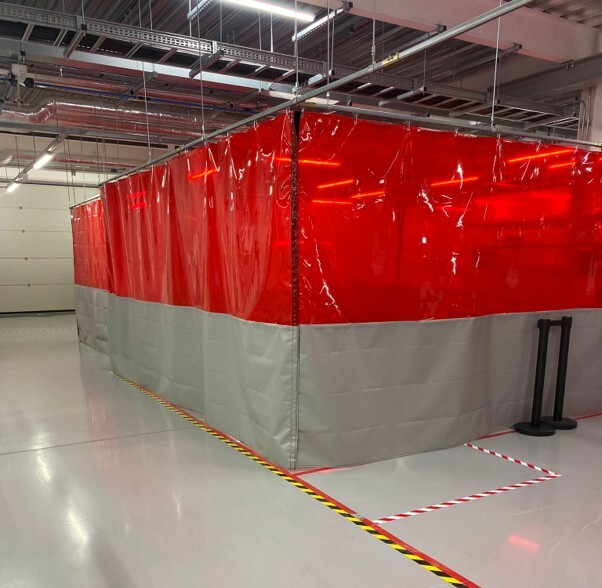
Heavy duty welding curtains create a physical boundary around the welding area, reducing the effect of cross draughts and helping extraction systems capture fumes more consistently and closer to where they are produced. By containing the immediate welding zone, curtains help maintain the stable airflow conditions that LEV systems are designed to work within, rather than leaving extraction to compete against unpredictable air movement from across the workshop.
In many cases, this simple addition improves real-world extraction performance more than any adjustment to the extraction unit itself would achieve, helping you to achieve greater compliance on the workshop floor.
Benefits Beyond The Welder
This segregation also benefits workers outside the welding area, reducing the spread of fumes, sparks and arc flash into surrounding parts of the workshop. Colleagues working nearby, walking through the area or storing materials close to a welding bay are less likely to be exposed to fumes that have drifted beyond the immediate work zone, and the same containment reduces the risk of stray sparks reaching flammable materials or other equipment stored close by.
Fitting Curtains Around Your Existing Extraction Setup
For workshops that already have a properly specified LEV system in place, adding heavy-duty welding curtains is often a relatively straightforward and cost-effective way to improve the airflow conditions around an existing extraction system, where cross-draughts have been identified as part of the problem.
The curtain works with the system already installed, addressing the airflow conditions around it rather than the extraction technology, which makes it a practical option for sites looking to improve compliance and performance without a major capital project.
Planning For New Fume Extraction Projects
Where a workshop is planning a new welding fume extraction system from scratch, considering curtain enclosures at the design stage, rather than as an afterthought once extraction is already installed, allows both elements to be planned together. This tends to produce a more effective result than retrofitting curtains around extraction equipment that was specified without accounting for surrounding airflow conditions.
Signs Your Extraction May Be Fighting Cross-Draughts
A few practical clues can point to draughts undermining an otherwise well-specified system, such as fume visibly drifting sideways rather than being pulled cleanly toward the extraction point, workers away from the immediate welding area occasionally reporting a smell of fume, or extraction performance seeming to vary depending on whether nearby doors are open or closed.
None of these signs necessarily means the LEV system itself is faulty, but together they often point to airflow conditions around the welding area working against it and an indication it could benefit from welding curtains.
Designing An Enclosure That Works With Your Extraction
Hutchinson's PVC Solutions designs welding curtain enclosures that work with your existing or planned extraction setup, helping your welding fume extraction perform closer to its intended capacity rather than fighting against draughts it was never designed to overcome.
Request a quote, and our team will assess your workshop to recommend a curtain enclosure that supports the extraction system you already rely on
No Comments Yet
Let us know what you think