.png?width=240&height=72&name=Untitled%20design%20(22).png "Untitled design (22)")


By Luke Hutchinson on Jan 8, 2026, 10:00:01 AM
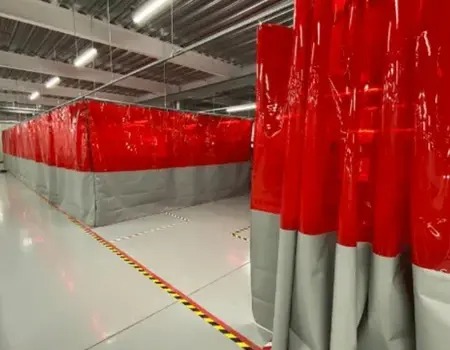
Welding remains one of the most hazardous activities in manufacturing environments. Beyond the immediate risks to welders themselves, welding operations expose nearby workers to intense UV radiation, sparks and toxic fumes, all of which can cause serious injuries if left uncontrolled.

The Health and Safety Executive (HSE) strengthened guidance in 2019 after welding fumes were reclassified as a carcinogen. It is therefore important for businesses to ensure compliance with these regulations.
For operations managers and safety officers, proper segregation of welding areas isn't just good practice; it's a legal requirement. Risk assessment plays a key role in determining whether your welding curtains comply with health and safety regulations.
In this article, we will discuss the risks associated with welding, workplace safety regulations, and how you can use industrial welding curtains for staff safety compliance.
Understanding the Risks of Welding Processes
The hazards associated with welding extend far beyond the welder's mask. Ultraviolet and infrared radiation can cause arc eye (photokeratitis) or flash burns to anyone within direct line of sight of the welding arc.
These painful conditions affect the cornea and can occur after just seconds of unprotected exposure, causing symptoms similar to having sand in the eyes, severe pain and temporary vision impairment.
Flying sparks and hot debris pose ignition and burn risks to bystanders. Molten metal and hazardous substances are also significant dangers.
Additionally, welding fume has been classified as a human carcinogen, capable of causing lung cancer and potentially kidney cancer. Even workers not directly involved in welding face these risks if proper controls aren't in place.
HSE guidance (HSG 204) and the Control of Substances Hazardous to Health (COSHH) regulations require employers to protect all personnel from these hazards, including those working in adjacent areas. The law demands that welding areas be clearly segregated and that protective equipment, including industrial welding curtains, meet strict safety standards.
Safety and Compliance Standards
Welding curtains are an essential part of industrial health and safety, and provide protection against welding arc light and flying debris from grinding. To comply with UK regulations, hanging welding curtains must be manufactured from flame-retardant materials that meet BS EN ISO 25980.
This international standard specifies requirements for transparent welding screens, strips and curtains. It requires them to be resistant to ignition, flame spread and UV light transmission. The standard ensures curtain materials won't ignite while welding and will self-extinguish once the heat source is removed.
BS EN ISO 25980 replaced the earlier EN 1598 standard and sets specific performance requirements for:
- UV radiation filtering to protect against arc eye
- Flame retardancy and self-extinguishing properties
- Optical transmittance levels for visibility whilst blocking harmful radiation
- Resistance to spatter and hot debris
High-quality welding curtain partitions are designed to absorb and filter harmful radiation whilst providing a physical barrier against sparks and spatter.
Factories can customise their welding booths depending on the process and visibility requirements. Opaque curtains provide complete isolation, while translucent screens allow supervisors to monitor work safely from outside the welding bay. Mobile welding bays offer flexibility for changing production requirements and can be relocated as needed.
Creating Compliant Welding Bays
Industrial welding curtains provide an efficient way to establish permanent, compliant welding areas without the extended timescales and disruption of traditional construction.
Using suspended rails or modular frames, these partition systems can be installed within 1-2 days, immediately creating designated safe zones around welding operations that meet HSE requirements. This speed represents a significant advantage over traditional building works and minimises the impact on manufacturing schedules.
For facilities operating multiple welding stations, such as automotive or metal fabrication plants, portable welding screens enable several compliant welding bays to be created simultaneously. Each station receives its own protective barrier that meets BS EN ISO 25980 standards. This creates a permanent segregation solution that protects workers whilst maintaining operational efficiency.
Protecting Workers And Maintaining Compliance
Facilities must now ensure effective engineering controls are in place for all welding activities, making proper segregation and fume control essential. Installing compliant welding curtains demonstrates a proactive approach to workforce safety and HSE compliance:
- They prevent accidental exposure to welding hazards, reduce workplace injury risk and help control fumes and heat, improving overall working conditions.
- The permanent segregation these systems provide ensures ongoing compliance with evolving HSE guidance.
- They reduce the risk of injuries and ensure permanent workplace improvements are installed with minimal disruption.
- Modern industrial welding curtains also provide sound attenuation benefits, reducing noise transfer between adjacent production areas. This creates a more comfortable working environment and improves concentration in precision-based processes operating near welding stations.
Meeting legal obligations whilst maintaining production schedules represents a critical balance that properly specified welding curtain systems enable facilities to achieve.
Meeting Your Legal Obligations
Given the increased expectations for HSE enforcement and the recognised carcinogenic properties of welding fumes, ensuring proper segregation of welding operations has become essential for compliance.
Industrial welding curtains manufactured to BS EN ISO 25980 standards provide a permanent solution that protects workers, meets regulatory requirements and can be installed quickly without extended production shutdowns.
Facilities that implement compliant welding segregation demonstrate due diligence in protecting workforce health while maintaining the operational efficiency that manufacturing schedules require.
Contact us today to discuss permanent welding bay solutions for your facility.
How A Retractable Spray Booth Saves Floor Space In A Small Workshop
How Warehouse Partitioning Systems Improve Climate & Combat Dust
No Comments Yet
Let us know what you think